



What Is Rapid Automatized Naming (RAN)? Its Cognitive Function and Potential for Enhancement

This article explains that Rapid Automatized Naming (RAN) is the ability to quickly convert visual information into spoken language, and that it plays a crucial role in reading fluency.
It also highlights that weaknesses in RAN can contribute to reading difficulties, and introduces the potential of multisensory learning—combining visual and tactile input (Sawaru Glyph)—to enhance RAN performance.
-
What is Rapid Automatized Naming (RAN)?
-
RAN Measures Automaticity, Not Knowledge
-
Why RAN Is Closely Related to Reading
-
The Relationship Between RAN and Dyslexia
-
What Cognitive Functions Does RAN Reflect?
-
Alphanumeric vs. Non-Alphanumeric RAN
-
Is RAN Universal Across Languages?
-
What Difficulties Are Associated with Low RAN?
-
Can RAN Be Trained?
- Enhancing RAN Through Multisensory Learning: The Role of Sawaru Glyph
The “see quickly, say quickly” function that supports reading fluency
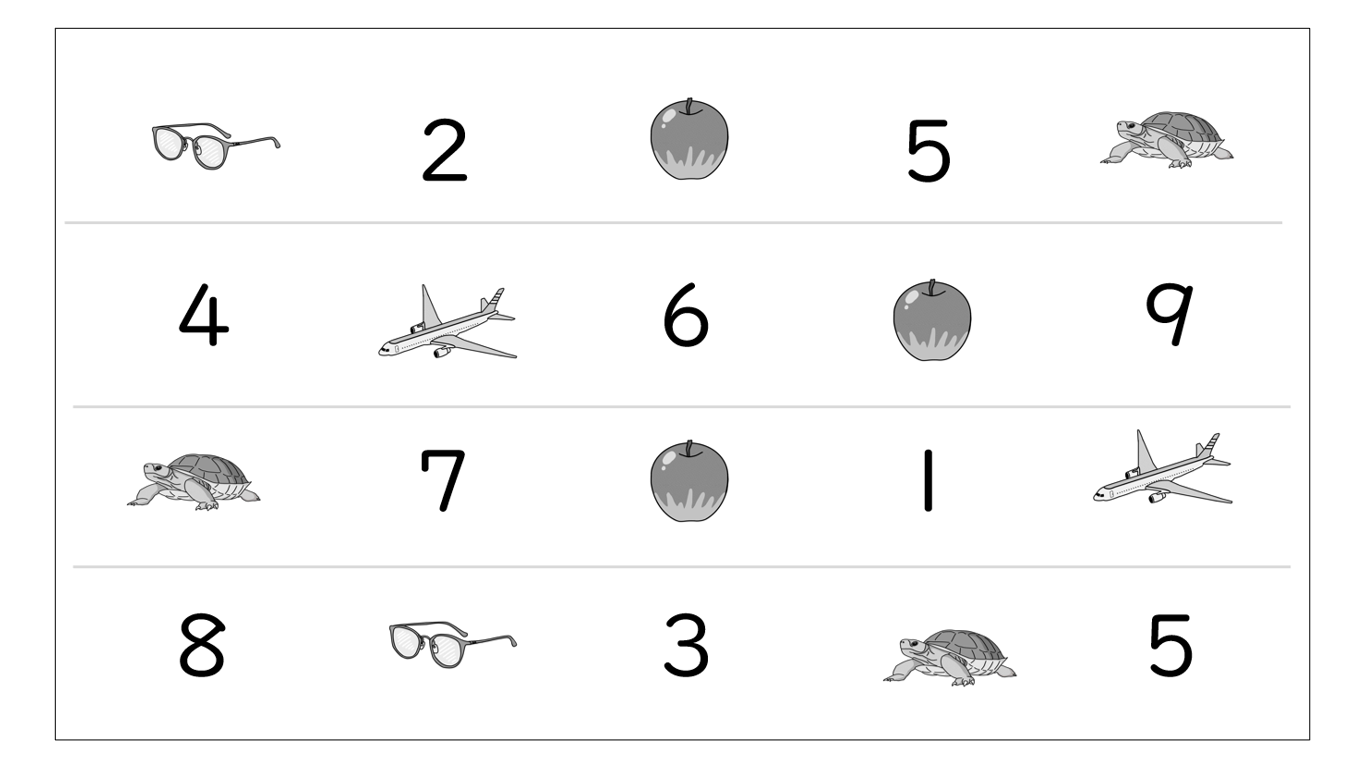
Rapid Automatized Naming (RAN) refers to the ability to name familiar visual stimuli as quickly, accurately, and sequentially as possible. In a typical task, items such as digits, letters, colors, or objects are arranged in a grid, and individuals are asked to name them rapidly from left to right and top to bottom. RAN was first introduced in the 1970s by Denckla and Rudel, and is now considered one of the most important indicators in research on reading development and dyslexia.
Although RAN may appear to be a simple task, it is in fact highly complex. It requires rapid visual identification of stimuli, shifting attention to the next item, accessing known lexical labels, retrieving phonological representations, preparing articulation, and producing spoken output. These processes must operate continuously and automatically. Therefore, RAN should not be understood merely as a measure of “vocabulary size” or “pronunciation ability,” but rather as a task reflecting the coordination of visual processing, attentional shifting, sequential processing, phonological access, and speech output. Norton and Wolf described RAN as a “microcosm” of reading fluency.
What RAN measures is not “knowing,” but “automaticity”
The essence of RAN lies not in whether one knows the name of a stimulus, but in how automatically that name can be accessed. For example, most children can correctly name the digit “3.” However, when multiple digits or letters are presented in sequence, differences emerge in whether they can process them continuously without hesitation. Some children with reading difficulties can read individual letters, but become markedly slower when faced with continuous text or sequences. RAN is particularly sensitive to such slowness in sequential processing and weakness in automaticity.
This distinction becomes clearer when compared with phonological awareness. Phonological awareness refers to the ability to segment and manipulate the sound structure of language. In contrast, RAN more strongly reflects the efficiency of accessing linguistic labels from already-known visual stimuli. Research consistently shows that while both phonological awareness and RAN are important for reading, they are not the same. Each contributes independently, with RAN being especially strongly associated with reading speed and fluency.
Why is RAN closely related to reading?
In reading—especially fluent reading—decoding each letter laboriously is not sufficient. Readers must visually process strings of characters, shift attention forward, convert them into phonological forms, and smoothly connect them to meaning. RAN tasks similarly require sequential processing of visually presented stimuli while rapidly producing their names. As a result, there is substantial overlap between the processes required for RAN and reading.
Accordingly, RAN performance predicts not only current reading ability but also future reading fluency. Empirical studies have shown that RAN is associated with reading across developmental stages—from preschool through school age and beyond. Review studies further demonstrate that RAN is a stable predictor of both current and future reading ability, making it a central construct in understanding and assessing reading disorders.
How is RAN related to dyslexia?
RAN is one of the most robust cognitive markers of developmental dyslexia. Early studies demonstrated that RAN performance helps distinguish children with dyslexia from other groups with learning difficulties. Subsequent research consistently shows that individuals with dyslexia exhibit significant deficits in rapid serial naming compared to typically developing peers. A 2019 meta-analysis confirmed substantial reductions in naming speed in dyslexic groups relative to age-matched controls.
Importantly, not all individuals with dyslexia struggle for the same reasons. Traditionally, deficits in phonological awareness were considered central. However, the double-deficit hypothesis proposed by Wolf and colleagues suggests that reading difficulties may arise from at least two distinct sources: deficits in phonological processing and deficits in naming speed. Individuals with both deficits tend to show more severe reading impairments than those with only one.
This perspective has important clinical implications. Even if two children both “struggle with reading,” one may primarily have phonological difficulties, while another may struggle with the automatic access from visual input to known verbal labels. Measuring RAN allows for a more nuanced understanding of the underlying nature of reading difficulties.
What cognitive functions does RAN reflect?
Not a single function, but the efficiency of a coordinated system
Reducing RAN to mere “naming speed” overlooks its complexity. Recent research suggests that RAN involves multiple processes, including eye movement control, visual scanning, selective attention, sequential processing, phonological access, and speech preparation. Eye-tracking studies show that children with better RAN performance exhibit more efficient gaze patterns and fixation behaviors, which are also related to reading proficiency. Conversely, slower RAN performance may reflect not only difficulty retrieving names, but also inefficiencies in visual anticipation, attentional shifting, and transitioning to subsequent items.
Studies in non-alphabetic languages, such as Chinese, also show that RAN is a strong predictor of reading ability and is associated with neural indices of attentional selection. This suggests that RAN is not limited to alphabetic systems, but reflects a more general cognitive function linking vision and language.
Alphanumeric RAN and non-alphanumeric RAN are not identical
RAN tasks can be divided into alphanumeric stimuli (letters and digits) and non-alphanumeric stimuli (objects and colors). While related, these are not identical. Alphanumeric RAN is generally more strongly associated with reading, particularly reading fluency.
However, non-alphanumeric RAN is also meaningful. Some studies show that object naming speed reflects differences in reading level more strongly than age, indicating its usefulness in assessing the efficiency of accessing verbal labels from visual input. Combining both types of RAN tasks may therefore provide a broader understanding of naming speed and reading-related processes.
Is RAN universal across languages?
RAN is considered a relatively universal predictor of reading across different writing systems. However, its role varies somewhat depending on the language. Cross-linguistic studies show that while phonological awareness contributes broadly to reading across languages, RAN is particularly strongly related to reading speed and decoding efficiency.
In languages with more transparent orthographies, RAN tends to manifest as differences in speed rather than accuracy. This is especially relevant for Japanese. In kana, where letter–sound correspondence is relatively consistent, individual differences in reading are more likely to appear in processing speed and fluency rather than correctness. RAN is therefore well-suited for capturing these differences.
What difficulties are associated with low RAN?
Children with weak RAN often show difficulties such as:
They can recognize individual letters, but their reading is slow. Their oral reading may sound labored and lack fluency. Because reading requires considerable effort, fewer cognitive resources remain for comprehension. In classroom settings, this can affect tasks such as reading from the board, following textbooks, and completing tests within time limits.
RAN helps identify such difficulties, which are not due to lack of knowledge but rather to problems in processing speed and automaticity.
Can RAN be trained?
While RAN has traditionally been treated as an assessment measure, recent research has begun to explore its trainability. A 2018 intervention study reported that phonological awareness training and RAN training have distinct, domain-specific effects, and that RAN intervention was associated with improvements in word reading speed. This suggests that RAN may be a viable target for intervention, not just observation.
However, caution is warranted. Compared to phonological interventions, the evidence base for RAN training remains limited, and the most effective methods are not yet fully established. At present, when RAN weaknesses are observed, it is most practical to adopt a combined approach—integrating support for phonological processing, reading fluency, visual–phonological associations, sequential processing, and attention.
References
- Denckla, M. B., & Rudel, R. G. (1974). Rapid “automatized” naming of pictured objects, colors, letters and numbers by normal children. Cortex, 10(2), 186–202.
- Denckla, M. B., & Rudel, R. G. (1976). Naming of object-drawings by dyslexic and other learning disabled children. Brain and Language, 3(1), 1–15.
- Wolf, M. (1991). Naming speed and reading: The contribution of the cognitive neurosciences. Reading Research Quarterly, 26(2), 123–141.
- Wolf, M., & Bowers, P. G. (1999). The double-deficit hypothesis for the developmental dyslexias. Journal of Educational Psychology, 91(3), 415–438.
- Norton, E. S., & Wolf, M. (2012). Rapid automatized naming (RAN) and reading fluency: Implications for understanding and treatment of reading disabilities. Annual Review of Psychology, 63, 427–452.
- Araújo, S., Reis, A., Petersson, K. M., & Faísca, L. (2015). Rapid automatized naming and reading performance: A meta-analysis. Journal of Educational Psychology, 107(3), 868–883.
- Lervåg, A., & Hulme, C. (2009). Rapid automatized naming (RAN) taps a mechanism that places constraints on the development of early reading fluency. Psychological Science, 20(8), 1040–1048.
- Georgiou, G. K., Parrila, R., & Papadopoulos, T. C. (2008). Predictors of word decoding and reading fluency across languages varying in orthographic consistency. Journal of Educational Psychology, 100(3), 566–580.
- Pan, J., Yan, M., Laubrock, J., Shu, H., & Kliegl, R. (2013). Eye-movement evidence for the role of rapid automatized naming in reading. Journal of Experimental Psychology: Human Perception and Performance, 39(6), 1737–1747.
- Uno, A. (2016). Developmental dyslexia. Higher Brain Function Research, 36(2), 170–176.
- Uno, A., Sunohara, N., Kaneko, M., & Wydell, T. N. (2017). Standardized Test of Reading and Writing (STRAW-R): Assessment of accuracy and fluency. Tokyo: InteRuna Publishing.
- Miyazaki, K., Hashimoto, Y., Uchiyama, H., & Sakai, M. (2025). Multisensory learning with haptic reading plates improved RAN(Rapid Automatized Naming), reading and writing skills. Cognitive Neuroscience, 26(3-4).“Original article in Japanese (日本語論文) | English translation (PDF)
- Miyazaki, K., Yamada, S., & Kawasaki, A. (2023). Visuo‐haptic multisensory learning enhances encoding and recall of Rey-Osterrieth complex figure shape. Cognitive Neuroscience, 24(3-4).Original article in Japanese (日本語論文) | English translation (PDF)